
From xkcd.com:
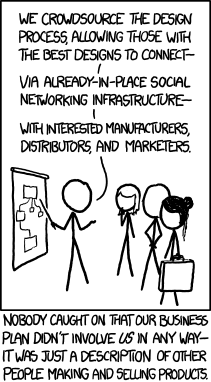
XKCD is always relevant, and this one struck me as especially poignant since it reflects my ultimate goal for crowdsourcing. Do you think the speaker realizes he is describing the death of his own job?
From xkcd.com:
XKCD is always relevant, and this one struck me as especially poignant since it reflects my ultimate goal for crowdsourcing. Do you think the speaker realizes he is describing the death of his own job?
 Ryan Walsh is a singer and guitarist for the Boston band Hallelujah The Hills. In celebration of their new album out this week, Walsh has teamed up with web comic Surviving the World to present a crowdsourced project to his fans. He asks participants to record their own personal melody for the phrase, “You can escape your fate but it’s not considered polite.” He’ll then sew them together into a single, collaborative musical masterpiece.
Walsh is accepting submissions until June 1st, so whip out that voice recorder, sing for five seconds, and email the MP3 or song file to ryan@hallelujahthehills.com. You could be a part of collaborative musical history, and/or win the entire HtH discography!
I’ve noticed a phenomenon in crowdsourcing that has plagued many a campaign. Spec work is its name, and after seeing it so often I thought it would be a good idea to share my thoughts on the matter.
 To start off, spec (speculative) work is any work where you are expected to put forth a commitment to your time and resources without the guarantee of getting paid. A good example of this is the contest model of crowdsourcing, where several hundred teams of creatives may put forward a product only to have one of them selected to receive payment.
I’ll admit, it seems bad. For an amateur artist, time and resources may be in short supply. To lend them out without the guarantee of compensation may be too risky for some. I myself see it as falling under the “Incentive” tenet of crowdsourcing, so let me see if I can’t justify it a bit.
The thing I feel drives a lot of people to spec work is that for them, it’s not primarily about the money. Much spec work is done by non-professionals who are simply looking for an opportunity to hone their craft. After all, spec work is almost always voluntary. Who else would sign up but people passionate enough about their work to do it potentially for free? A lot of contest-model sites embrace this notion, offering their members educational materials or access to other members for learning purposes. Money is a bonus, but simply a secondary concern.
 There is something else I didn’t realize until I spoke to a friend of mine who had entered a shady poetry contest in his formative years. He didn’t find out it was a scam until later, and although he was disappointed, he was still glad that he had gotten the chance to show off his work. He told me that the “spec work” aspect of it didn’t bother him so much; almost all artists start out doing entirely spec work to help them make a name for themselves. It’s part of the game, he told me, and I happen to agree. If you’re trying to get by on creative talent, it’s practically accepted that getting paid for it is not going to happen right away.
So we have the amateur and part-time creatives finding things to enjoy about the spec work model. That leaves the full-timers, the creative professionals, a group I could definitely see having a problem with the concept because they’re accustomed to guaranteed payment for their efforts. But as I mentioned, spec work is both voluntary and primarily not about the money. Full-timers would be wise to mostly avoid the spec work market, leaving it to the amateurs and part-timers. This ensures that companies will still turn to professionals for their highest-quality creative needs.
Voila, spec work in a nutshell. If you’re a non-pro, spec work is a great way to hone your craft and get your name up. If you’re a pro, it’s probably not what you’re looking for. Overall, I’m a fan of the idea; after all, spec work forms the basis of a ton of creative crowdsourcing efforts. What’s your experience with spec work been like? Enchant us with your tale in the comments.

© 2012 Chelsea and Westminster Hospital
HIV and sexual health clinic 56 Dean Street is teaming up with (awesome) actor Stephen Fry to crowdsource ads designed to raise awareness of HIV. Focused around the Community Campaign Facebook page, the campaign follows the typical “contest” model of crowdsourcing. Ads will be openly accepted from all comers, and the crowd will vote to decide the winners. The best ads will be displayed across multiple media outlets, and heavily featured in prominent London gay bars.
I love campaigns like this, because they target exactly the right audience. The ads will be primarily geared towards gay men, a community already famous for their unique style of creative flair. Add that to the videographers and other content producers from all circles; they’re more than eager to tackle hot-button issues like HIV, since a controversial or popular video provides publicity for its creators. Also, 56 Dean attaching Stephen Fry to the project opens it up to his entire fan base. Some may not be particularly passionate about HIV awareness or the gay community, but they’ll support anything backed by their idol anyway. Heck, I might not have even seen this campaign if his name didn’t catch my eye.
Essentially, we’ve got a “perfect storm” of creatives that will be chomping at the bit to produce an ad like this, and 56 Dean Street is going to receive an enormous number of submissions. And as a bonus, since this is an awareness campaign, even the process of voting for the final ad will contribute to their overall cause. This is well-done crowdsourcing, and I think 56 Dean will be very pleased with the results. Look to the Facebook page on August 13th, when the submissions will be in and voting can begin.

Copyright © Daily Crowdsource
From Microtask’s Ville Miettinen:
“The thing is, in the crowdsourcing industry we are hard-wired to spot crowdsourcing opportunities. All of us familiar with the power of crowdsourcing constantly expect companies like Google to capitalize on the huge crowds it has access to. A feature like Ask on Google+ can look to us like the seeds of Google finally recognizing the massive untapped potential in its crowd.”
This is all regarding a “Yahoo Answers”-type update that Google rolled out recently. The update would allow you to ask questions to your Google+ network if a search result turns up unhelpful or inconclusive. It’s not the most error-free solution, but the quote above gets my gears turning when it comes to what a company like Google could do with the people they have access to.
 Tiny Work