Tag Archives: Advertising

Peter LaMotte Clears The Air About GeniusRocket at TEDxWDC

10 Jul

Many of you may remember my less-than-kind critique of GeniusRocket a little while back. Peter LaMotte, the president of the company, was so kind as to comment on the article (amicably!) and invite me to their DC office to discuss the matters further.

Our meeting was an eye-opening experience, and I am much more at ease with how their model works now. If you’re still wondering how this story shook out, this speech, given by Mr. Lamotte at TEDxWDC, may shine some light on the GR process. The company is nowhere near as bad as I originally thought; they’re just geared towards a different type of audience than I expected.

It Would Have Been a Great Story

14 Jun

I was supposed to have a great, full-length post for all of you today, but it turns out I was taken for a ride and my source was fake.

© 2005 Marvin Harrell ~ stock.xchng

It’s a true shame; it was a story about a major company (unnamed; they’re probably catching enough flack for this already) who launched a campaign asking users of their website to design a print ad for the chance to win a trip. Whoever developed this prank, or whatever it is, set up an entire site for submitting, viewing, and voting on these ads.

But as the submissions trickled it, it was clear that they weren’t going in the direction they were supposed to. This unnamed company has some pretty shady business practices, and the vast majority of the submitted ads called these practices into question in ways that wouldn’t be considered “kind” or “not heavy-handed”.

It would have been brutal if it was true. Imagine a company blindly launching a campaign without being aware of the general populace’s opinion of them. And imagine the campaign entirely involved having people plaster whatever message they want on a professional-looking ad with your company’s name and logo. It would have been a fiasco.

Unfortunately, the campaign was created not by the company, but by some outside force that opposed their politics. Further digging into the website proved it was all subtly tongue-in-cheek,  designed in such a way that it would only reveal itself as fake if you gave it more than a cursory glance.

So why was I taken in at first? Because this company wouldn’t have been the first one to make a mistake like this. A big aspect of crowdsourcing that continues to keep some companies away is the lack of control and privacy. When you host a contest like this, it does indeed become exceedingly important what the public’s opinion of your company is. If your company is controversial, crowdsourcing will provide you with messages that promote both sides of the issue. Unfortunately, there is usually one side that yells louder, and that’s the dissenters.

So is there a lesson we can learn from this? Crowdsourcing is best suited to companies that already have a large positive following. Will it completely stop situations like this? No, but a lot of consumers on your side certainly helps support the messages you’re actually trying to promote. Conversely, if your company is afraid of what the populace has to say about them… well, maybe they should reconsider how clean their hands are.

Slogan Slingers: How Does $30 Per Word Sound?

1 Jun

Slogan Slingers

$30 per word is how much you could be paid if you can turn a phrase in precisely the right manner. Slogan Slingers is the first crowdsourced contest site that specializes exclusively in slogans. They take creative briefs from their clients, send them to their network of professional and non-professional writers, and receive hundreds of slogan ideas from which the client picks (and pays) the best one.

Honestly, there isn’t a ton separating Slogan Slingers from other contest-model-creative-endeavor sites, but it’s worth mentioning that this is a very attractive prospect for the busy creative. It takes virtually no time to write a slogan (most are shorter than a tweet), and the rewards start at $200 and climb all the way to just shy of a grand.

This means that your of wining odds are slim, however; of the three contests I looked at on the site, all had over 80 entries after being listed only two days. An understandable downside, since the potential value is so great, but the odds are still a little daunting.

However, if you can overlook all that… $30 a word, man. That last sentence could have made me $300. And who hasn’t seen a company with a terrible slogan and thought “I could do better”?

Sidenote: Although Slogan Slingers’ FAQ states the minimum contest prize is $200, I see some contests on the site with prizes of lesser value. I don’t know what’s up with that, but when I do I’ll make an edit to this article. And that edit is: they’re running a limited-time promotion. Entry fees and prizes are reduced. Quote from a Slingers team member:

Typically our contests start at $200.  Writers had emailed us saying they they wanted to see more contests started so we are doing some price testing over the next few weeks (and maybe beyond) at a lower entry price to see if that generates more contests.

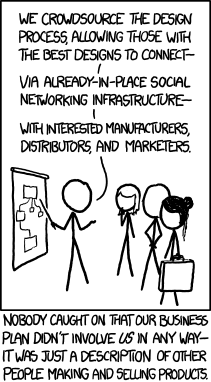
XKCD on Crowdsourcing

25 May

From xkcd.com:

We don't sell products; we sell the marketplace. And by 'sell the marketplace' we mean 'play shooters, sometimes for upwards of 20 hours straight.'

XKCD is always relevant, and this one struck me as especially poignant since it reflects my ultimate goal for crowdsourcing. Do you think the speaker realizes he is describing the death of his own job?

The Second-Best Swordsman; What GeniusRocket Is Doing Wrong

9 May

I’m not gonna beat around the bush with this one, kids. The ad-production company GeniusRocket claims to be a crowdsourcing agency, but they suck and you shouldn’t use them. Today’s lesson is about what crowdsourcing isn’t.

GeniusRocket - The First Curated Crowdsourcing Company

What crowdsourcing isn’t: Exhibit A

Cruise on up to that “What Is Crowdsourcing” tab at the top of the page, and scope the second paragraph. “Crowdsourcing involves taking a task that would ordinarily be completed by a hired individual or group, and instead hosting an open call for whoever wants to work on the task to do so.” GeniusRocket drops the ball right off the bat by using a “curated crowd“. From the site’s Community page:

“Every member of our community is vetted for their experience and expertise. As a result you won’t find amateurs or students. In other words, you won’t find people in our community that are trying break into the business by working on a client’s project.”

Red flags right there. By having such a stringent process for being a part of their crowd, GeniusRocket essentially takes away everything that makes a crowd a useful thing. This is a difficult concept to wrap one’s head around, but it’s called the Diversity Trumps Ability Theorem and it basically states that a varied group will outperform a group of experts every time. Mark Twain explained it best, if you’re willing to accept metaphor:

“The best swordsman in the world doesn’t need to fear the second best swordsman in the world; no, the person for him to be afraid of is some ignorant antagonist who has never had a sword in his hand before; he doesn’t do the thing he ought to do, and so the expert isn’t prepared for him.”

A group of experts, with the same talents, same education, and similar backgrounds, will always come up with the same ideas that they’ve been coming up with forever. A diverse crowd will offer a multitude of perspectives, which more often than not leads to breakthroughs and inspiration you simply won’t get from a homogenized group of professionals that have done the same thing, the same way, for their whole lives.

Pictured: Not The Crowd You Want Helping You

As a result, you’ve got a company that wants to have the advantages of crowdsourcing but is afraid of the risks, so the service they offer is simply the illusion of crowdsourcing. You’ll get varied ideas from different perspectives, if your definition of “varied” and “different” is actually “same as it’s always been”. And you don’t have to take my word for it; watch some of their ads. They’re terrible, pointless, or disturbing at worse and average at best.

Now, the platform is salvageable, but they need to make some big changes. Namely, they need to realize that by definition of both terms, there can be no such thing as a “crowdsourcing agency”. So hey, GeniusRocket execs, if you’re reading this: shoot me an email. Something has to change at your company and I’d like to help you with it instead of bitching about it on the Internet.

Design a site like this with WordPress.com
Get started